Showing posts with label collapse weave. Show all posts

Monday, September 25, 2017

Collapse weave - finally!

I am sure you remember all my collapse weave experiments from the spring and the spinning of the singles during the Tour de Fleece. Well, I finally got around to warping and weaving the scarf and it turned out exactly as I had hoped. The challenge with collapse weave is that it is unpredictable so getting results that are sort of what you wanted is wonderful.

 This is the warp. 2 sets: one S-spun and one Z-spun. These were sized with xanthan gum.
This is the weft. I had 2 skeins of roughly the same size. I chose to use the larger skein but I should have gone with the smaller one. Oh well.

The warping process was very easy. The sized singles were a bit stiff and smooth. I ran out of the Z-spun singles so the warp was not as wide as I had planned. I still have a bunch of the S-spun ones. I warped the S-spun with 2 strands in a slot and hole for 1/2" and then the Z-spun for 1" with 1 strand in each slot and hole. So the S-spun was more tightly sett than the Z-spun. I used a 10 dent heddle which is pretty wide for this fine of a yarn. But one needs to leave a lot of room in between the strands to allow them room to collapse. This is similar to what we have to do with felting in knitting.

You can't see the difference in the sett in this photo that I took as I started weaving. 

The gradient goes from a magenta to a grey through blue and violet. I wanted to make sure I had the warmer end of the gradient so I started weaving from the magenta end. You can see the range on the right hand side of this photo.
I did 6 picks packed tightly and then 8 picks at a balanced weave. The 6 picks came out to be about 1/2" and the 8 picks came out to be about 1" to mimic the warp.

The weft was not sized so I was afraid to wind it into a center-pull ball. I wanted to keep the yarn under tension. So I wound it onto a tennis ball. Then I had to rewind it so that I was starting with the correct end. The singles had broken in one spot when I was winding them onto the niddy-noddy. So I wound off till I hit the knot, undid it, and then rewound it onto the shuttle so the undone knot was on the inside of the shuttle and the magenta was on the outside. Then it was time to start weaving.

The weaving went fast. Since there are no color changes, it was a matter of just paying attention to the denser and looser weaves. 

 Once it was off the loom, it looked like this. It is easy to see the thicker and thinner parts in this photo, both on the warp and the weft.

Before washing, I had to finish the fringe. I couldn't separate the S-spun and the Z-spun into separate fringe elements so I ended up braiding them to make sure they stayed OK. They got a bit distorted after washing but they still look nice.

 The magic happens in the water. I soaked the scarf in a few baths to get rid of the sizing. Each bath was about 10-20 mins long. Then I hung it up to dry.

 Here's the finished scarf after drying. I hadn't trimmed the fringe yet but otherwise it is complete.

This photo shows the texture. I was looking for that crinkly square-ish effect and that is what I got. It didn't curl up into a spiral which is what I was afraid of.

So I declare this project a success!

Friday, July 28, 2017

Tour de Fleece results

I am very impressed with my spinning efforts this year. I had two objectives:

  1. Spin the singles for warp and weft for a collapse weave project
  2. Card and spin the locks I dyed at Rhinebeck last year
I achieved both and also spun about 1/3 of 2 Fiber Optic braids that didn't quite match. That will get finished in its own time.

Here are the final results of the Tour de Fleece 2017 for me in pictorial form. The photo represents the state of the spinning at the end of the Tour last Sunday night.

Since then, I have finished all the yarns except for the partially spun red braid.

The carded and spun locks made a nice DK-sport weight yarn. It is difficult to capture the actual color as it is a bit darker than this. It either looks black or it looks a bit too bright like this. I am very happy with it. It has a nice hand. It is a bit lumpy and bumpy but not too much.

I started plying from 3 bobbins, one of which had quite a bit less than the others. When that one ran out, I made a rather large plying bracelet with the larger of the two remaining bobbins and continued spinning a 3 ply. When the bracelet ran out, I used the loop from the end of it to start a chain ply with the last bobbin. Since that was the one where I had started with single color rolags, the chain ply created a single color yarn. You can see that on the coin. The rest of the yarn is marled as the rolags were blended and then they were plied. I am in love with the colors! I also got a lot more yardage than I had thought I would. It is about 132 yards.

Then I finished the weft yarns for the collapse weave. I wound them on a PVC niddy noddy and soaked them while they were on there and let them dry under tension. This was to control the twist so I can weave without getting pigtails in the weave.


Lastly, I finished the warp yarns. These were also wound on the PVC niddy noddy and soaked but then I applied a xanthan gum sizing per Sarah Anderson's Spinner's Book of Yarn Design. She recommends 1 tbsp of xanthan gum to 2 cups of water. The water has to be put into a high speed blender and the blender started. Then the gum is dribbled in from the top opening. This way you get an even mixture or goop as we will call it from now on. That is the goop in a plastic container on the counter.


I had soaked the weft in the bathtub but found it awkward. So this time I brought it down to the utility tub and soaked it there, Then I squeezed out the water as best as I could. I applied 1/4 cup of the goop by hand putting small amounts on each section of the fiber and massaging it in. I squeezed out the excess and ran my hands over the fiber to smooth out any blobs of goop. I left the skein to drip in the tub and then I took it upstairs and stood it up in the guest bathroom sink. I had done this with the weft and I knew that it sat in there very nicely with stability. I was afraid that if I left it in the utility tub, someone would run water over it accidentally.

I finished the Z-spun warp first and it was dry in 2 days. As it dried, I went by periodically and made sure that strands weren't sticking to each other. I wound this skein as I normally do, tightly. I found that it was difficult separating strands when it was wound so tightly. I had,  I also wound it with strands overlapping each other. Fortunately, tied the figure-8 ties loosely. I always do that so that the twist and the water can get in under the ties.
It is stiff but each strand is separate. Sarah Anderson recommends winding it into a ball which I will do before I warp.

Today I repeated the process with the S-spun warp. I wound the skein much more loosely and also made sure to lay each strand next to the previous one making sure they didn't overlap. That made it easier to separate the strands after the goop was applied. I will continue to separate them as it dries. It looks exactly like the skein above. I made sure to label the first skein so I wouldn't get them mixed up.

My plan is to alternate the S and the Z spun warps with the Z-spun threaded more loosely on the heddle and the S-spun threaded at double the density or sett. The relative sizes of these that I found aesthetically pleasing was 1" with the wider sett and 1/2" with the denser sett. I am thinking I will use a 10 dent heddle. I need to calculate how wide and long I can make it now that i know how much yardage i have. I need a wide sett to provide space for the weave to collapse but I also want some structure. I don't want it all to collapse into a crumpled ball!

This is the look I am aiming for but doing it on both the warp and the weft. In the sample, I only did it in the weft.
If you look at the top, I have done the 1" loose and the 1/2" dense. The bottom was done with 1" each and I didn't like that. The denser sett reduces the collapse providing the ripples. I am also alternating the S and Z spun warps so that the twist pulls the fabric in opposite directions, again providing some structure.

But it is all a big experiment so it will be interesting so see how it turns out. Stay tuned!

Tuesday, July 18, 2017

Tour de Fleece 2017 progress

It is amazing what you can get done when you are not at work all day!

I have been spinning every day and as a result have made a lot of progress on a number of fronts. The warp and the weft for the collapse weave project are all spun. I even have a PVC niddy noddy ready to finish the yarn to be ready for weaving (more on that below). I finished this so fast that I added another project to my TdF list this year.

 These are the two halves of the weft. I divided the braid in two so I would get shorter color runs which would ensure that I was able to fit the entire gradient into the project. I can always add more colors from the other half as needed.

 This is the Z spun warp. I am hoping to use just this for the warp but I have a backup plan in case I need more yardage.

I have some S spun singles from the sampling back in March. I spun some more in the S direction so that I can alternate S and Z spun singles if I need more yardage.

Next up on these is to set the twist temporarily so that I am able to weave without getting pigtails from the twist. I had a problem with this when I wove the samples. I thought that letting the singles rest would make the twist dormant enough. But it didn't. So now I am going to wind the singles onto a PVC niddy noddy and wet and dry them under tension. Additionally, I will add a sizing to the warp so it will have a bit more strength and will move through the heddle more easily. I am planning to use a xanthan gum solution for sizing. This will wash out when the woven item is wet-finished.

There is the PVC niddy noddy. I need this because my wood one will absorb the water and could get damaged by the damp. I also took this opportunity to make a 2 yd niddy noddy. My wood one makes 30-32" skeins, not quite 2 yds.

I also am carding and spinning the locks i dyed. I initially thought I'd keep the colors separate but I prefer to let them get blended or stay separate rather randomly so I am doing it as they come to hand.
I pick, I card, and I spin. Then I repeat. This keeps my hands from getting too sore from one activity.

A couple of piles of rolags.

And here's the yarn.
That is one full bobbin on the left and the second bobbin I started on the right. I am spinning this on the Tina II and loving the process of treadling. I think I am going to keep a carding project going on the Tina II while I spin top on the Hansen.

Since these are going so fast, I decided to add in a third project. I have these two braids which are both the same red but one is cool and one is warm. Here they are.
 The two braids where you can see the difference. To make sure that they don't clash, I am drafting them together so that the final yarn will have bits of each read blended together.

 This is how I hold the two braids. I divided each braid into 4 width-wise and am holding the entire width of each braid in my hand and drafting.

Here is one quarter of the project done. This is 2 oz. 1 oz from each braid.

Lastly, I finished the color gamp Shetland scarf. I wanted to get it done so the loom will be free for the collapse weave project in August.

I got tired of changing the weft every 1.5" so after doing 1 set of each color, I started doing 4.5" (3x1.5) stripes in the middle. Two sets of those and then a repeat of the 1.5" stripes on the other end. I am in love with the way the Shetland looks and feels in this scarf. I have more of the Harris tweed Shetland yarn and I am going to weave more scarves with it.

I also splurged and bought a lovely new supported spindle. I haven't used it yet but I think that after the Tour de Fleece is done, I am going to spend some time spindling.
It is from Glasspins, by Mingo and Asho. They had a sale on. The glass focal is a red and gold swirl but I love the body. It is bird's eye maple. My favorite wood.

Next time I hope to show you the finished warp and weft for the collapse weave and even maybe a plied yarn from the locks. 

Sunday, July 2, 2017

Tour de Fleece 2017

The Tour de France started yesterday and in parallel, our Tour de Fleece started at the same time. This is the first year I am going to be home for the whole tour and since I recently retired, I am hoping to get a lot of spinning in the next 4 weeks.

I had a plan for the major project I wanted to do but I didn't work out the details till sometime between Friday and Saturday. I like to learn during the TdF by doing something new to me and over the years I've learned a lot of techniques this way - long draw, ply-on-the-fly, extremely fine spinning, etc. This year's project was to spin for a collapse weave scarf or shawl. Remember all the samples I made? They were to figure out what I wanted to do.

I have a secondary project that I want to do - spin from the lock with fiber I have processed myself.  This is in case I get bored or finish the collapse weave spinning too quickly. Since I am spinning singles for collapse weave, it goes fast. No plying!

Therefore the first factor in selecting fiber is the objective of the project. The second factor is what equipment I will use. When I travel, I am limited to spindles. Since I am home this year, I can use my e-spinner and my wheel. I am going to do the collapse weave yarn on the e-spinner and the spinning from the locks on the wheel.

The third factor is what teams I can be on. I try to double up on teams for the same projects :-) This year they are Team Footloose (e-spinner), Teams Fiber Optic and Gorgeous Gradients, and Team DIY and Dye.

 This is the gray Corriedale I bought in New Zealand. I used it for the collapse weave samples and spun a S-twist singles. This time I am going to spin it Z-twist so that I have the option of alternating S and Z twist in the warp. I may not do it or I may. But if I have singles with twist in both directions, I have options. I also have a lot of this so I don't mind giving some of it up to loom waste. :-) This will be the warp for my shawl/scarf.

 I had spun a bit of this before yesterday, but very little. Rather than starting a new project, I thought I'd continue with it and spin singles for the weft. I had split it into two and that is why I was torn about using it. But I decided that it was for the better. If I spin it completely end to end, I am tied to the length of the transitions as they appear. By stripping it vertically, I reduce the length of the color repeats. This means that I will get all the colors in a scarf or, if I end up doing a shawl, I can remove the last color from the second half and weave it in reverse to make a mirror-image shawl. So I'd start with gray (say) and weave to the magenta, Take off the magenta from the other singles and weave back to gray. Or just weave to the blue, remove the magenta from both singles and part of the blue from the second one and weave back to gray. I think it will give me more options. Since I've never done this before, options are good.

 These are the locks I dyed last year at a class in Rhinebeck. I had previously washed the locks so I started the processing with the fleece itself.  I am not sure how I am going to handle the colors. I may just let them come as they may or I might try making a self striping yarn.

 This is the first day's spin. The top is what I had done previously. As you can see, it is very little. I wasn't able to spin yesterday till after dinner but I got a bit more than an hour of spinning in.


 I also went to the yarn store and got photos of myself in the zippered hoodie.

I have made progress on the Grapevine pullover. I am halfway down the first sleeve. I decided to put a band of the lace at around the elbow. I picked a spot where I had the right number of sts for the repeat of the lace and put in an insertion. I will also do the same at the cuff.

No progress on the weaving. I was busy trying to get all the yard-work done before the heat set in in earnest. And I made it. Now I just have to keep the weeds down by doing a patrol every few days and it doesn't take much time to pull out the ones that have sprouted in the mean time. I think my sage is dying though. It is wilted even though I been watering regularly when it hasn't rained. The rest look good.

I am going to try and collect some flowers for dyeing in the winter.

Monday, April 17, 2017

Results of Collapse weave experiments

The collapse weave experiments are done and I have my plan for the Tour de Fleece. As I said last time, I planned to do four sets of samples. Each set consists of two identical samples: one to remain unwashed and the other to be washed and finished.

I hemstitched each sample. I did not size the singles. I think I need to do this because the single got very twisty and was difficult to weave with.

Sample set 1: This was done with a high-twist, very fine, dyed Polwarth single. It was spun with Z twist from top. Spun with a short forward draw. The discrepancy between the thickness of the warp and the weft meant that this became warp-focused and the color variation in the weft is not visible. But I liked the feel of this. With a thinner warp, this would be a lovely fabric.
This is one of the samples on the loom.

This is the completed set. Washed on the left and unwashed on the right. The unwashed sample is curling from the twist I think.

Sample set 2: a thicker, lower twist single spun Z from a cream/taupe striped Corriedale roving. This was spun with a supported longish draw. I striped the weft by packing it down more densely to create stripes. This is my favorite and what I will be spinning for during the Tour de Fleece.  I will weave a scarf with self stripes in the warp and the weft using the same singles yarn.
On the loom.
Completed set. Washed on left and unwashed on right.

Sample set 3: Singles were spun with S twist from gray Corriedale roving. Spun with a short backward draw. This is what the dyed Polwarth would look like if the singles were thicker. The gray makes the colors in the warp pop.
On the loom.
 Completed set. Washed on left, unwashed on right. This is also curling but see how nice the fabric is on the washed sample. I liked this one a lot also.

Sample set 4: Same singles as above but I added stripes of the warp, which wouldn't change in the finishing as it is a balanced yarn.
 On the loom.

Completed set. Washed on left, unwashed on right. This also makes an interesting fabric and something I may try with a different warp at some time.

Overall, I found the process fun and I learned a lot. Sarah Anderson recommends sizing with a xanthan gum solution to control the twist while weaving. It washes out in the finishing. That is what I plan to do. I want to spin a thicker, slightly lower twist singles from the dyed top and do the self striping, which will provide some structure to the fabric. The only question in my mind is whether I ply the warp yarn and just use singles in the weft or use singles for both.

Next, I am playing with spinning stretchy yarns for socks so stay tuned...

Tuesday, April 4, 2017

Collapse Weave Exploration

When I spin or work out, I need entertainment. Sometimes I listen to podcasts. But frequently I need something to look at. Spinning and weaving videos work well to entertain me. They inspire me, give me new tips, and reinforce older ones. Things that went right over my head when I was newer to spinning make sense now when I watch those videos again. Some of my favorites are by Sara Lamb, Sarah Anderson, Judith MacKenzie, and Patsy Zawistoski. The first three teachers have videos on Interweave and Patsy Z's are available via DVD on her website.

Anyway, I was watching Kathryn Alexander's video on Energized Yarns and she mentioned that they can be used in weaving. Then I watched Sara Lamb's video on Spin to Weave and she talked about weaving with them. I did some googling and found a book by Anne Field called Collapse Weave and most of the other information on the web was related to her book. There was a few independent blogs and artciles but not much. Knitty had a blog on it. I bought the book and read as much of it as made sense to me. But I am smitten.

The book is mostly about weaving on a floor or table loom and I haven't figured out my floor loom yet. Therefore, that was not an option. But some of the early stuff in the book is simple plain weave or tabby. I felt I could do something with that. The basic concept is that you spin singles and leave them as energized yarns. The energy goes dormant as the yarn sits, or you might have to tame it by wetting and letting it dry with a weight on it. Sometimes you even have to add sizing if you want to use it as warp.

However, after you weave, you soak it in water to finish it and the pent-up energy is released and it makes the cloth turn into a 3-dimensional work of art. I bet there are some works of horror too. But we won't think of that.

The next stage of this journey had to do with the Tour de Fleece. Someone on Ravelry asked what my plans were for the Tour de Fleece this year, and suddenly I thought about weaving singles for a collapse weave project. But I didn't want to spend a lot of time spinning something that wouldn't work. And that led me to the experiments in this post. I need to spin and weave some samples before I plan my Tour de Fleece spinning.

I decided to try 3 different types of energized singles. Maybe these distinctions won't make a difference but I have to start somewhere, right?

I spun these three yarns.
 From left to right: dyed Polwarth top spun worsted with a Z twist into a fine, highly twisted singles yarn; cream undyed Corriedale roving spun longdraw with a Z twist into a slightly thicker, highly twisted singles yarn; gray undyed Corriedale spun with a short backwards draw with a S twist into a slightly thicker, highly twisted singles yarn.
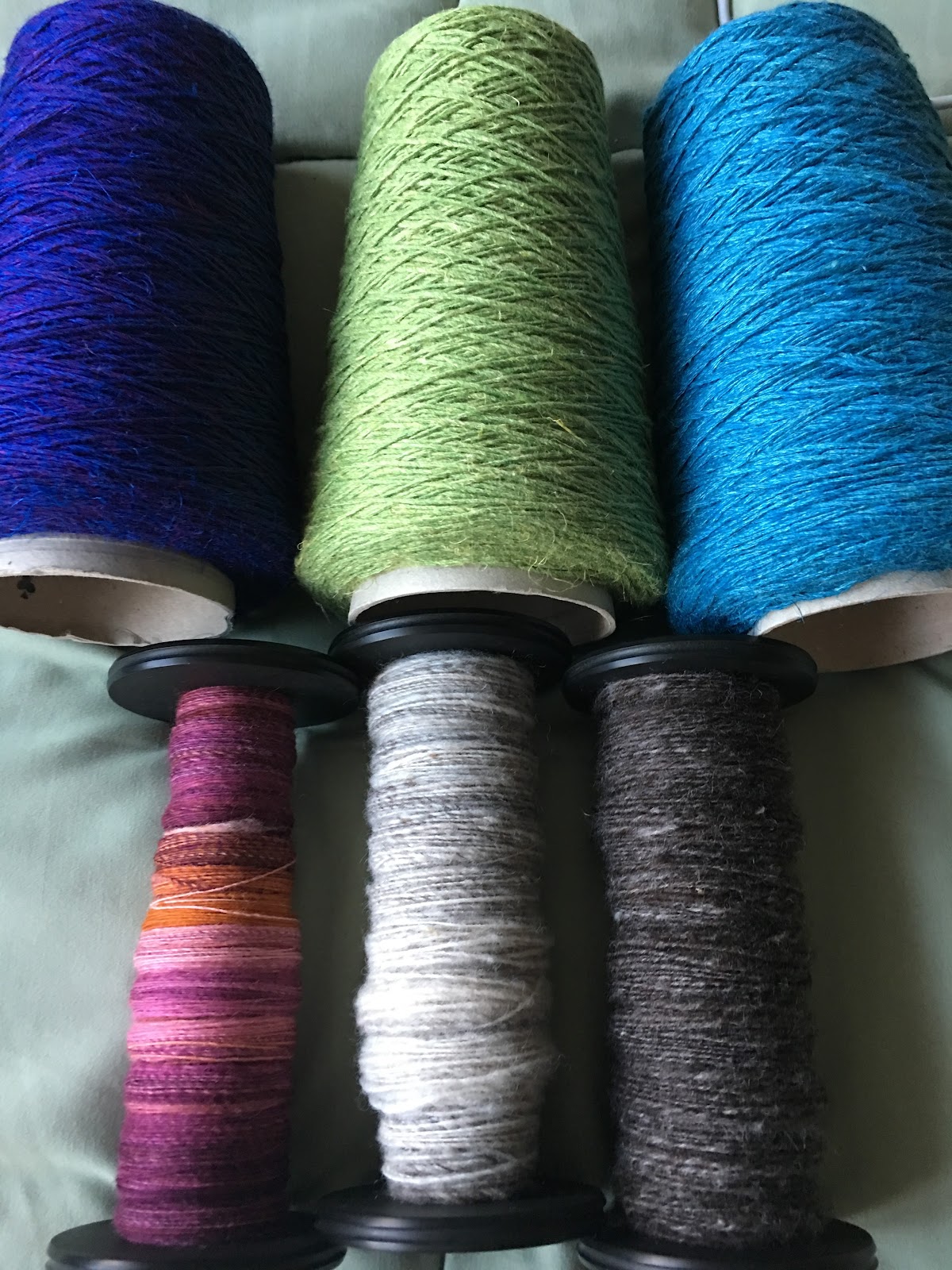
 The top 3 cones are my warp. I chose some linen/silk that I had on hand from Colourmart. I wanted something that wouldn't shrink to provide structure in the fabric. I also am not sure which of the colors will look good so i decided to try them all.
 I've warped the loom and put on a header and am ready to go. The warp is 4 yds long. I used a very wide sett - there is a lot of room between the warp threads to give the energized yarn room to move. I plan to weave 4 sets of samples. Each set is 2 identical samples: one will be washed and finished and one will remain unwashed for reference.

  1. A 12" sample with the dyed worsted fine singles as weft.
  2. A 12" sample with the cream woolen yarn as weft but make stripes of more closely packed weft and a balanced weft which will be spread further apart. 
  3. A 12" sample with the gray semi-woolen S twist yarn as weft
  4. A 12" sample with the gray yarn striped with the warp yarn
The objective of the two striped samples is to experiment with differential shrinkage. This is where one yarn shrinks a bit more than another one and creates a gathered or crinkly effect. If you remember seersucker fabric, that is achieved by differential shrinkage.

This is a search for collapse weave projects on Ravelry. This is another blog with some details of collapse weave. I provide these as references in case you are intrigued by my journey and want to follow along.
And now that I've finished that spinning, I am pondering my next project. I want color. I pulled these 4 braids out of my stash but I'm torn as to what to spin. I've asked on Instagram and on Ravelry and so far the Fiber Optic gradient has a slight edge although all 4 braids have received votes. What do you think?

The knitting is also making progress. I've finished the body and need to pick up and knit the pockets next.
Then come the sleeves and the hood. This is a mashup of Giorgia, Cross Pockets, and Rogue. The raglan shaping is from Giorgia because my row gauge matched that pattern more closely than the row gauge on Cross Pockets. The body below the armhole is mostly based on Cross Pockets because I wanted to see how that design looked on me before I went through the effort of figuring out the shoulder and armhole shaping at my row gauge. I also like the hood shaping on Rogue so I am going to adapt that for the hood. The color in this photo is a little washed out as I used the flash to eliminate shadows. It is a bit brighter than this. A rose color. The yarn is Rowan Calmer in the colorway Mandarin.

And that's all for now, folks!