Showing posts with label long draw. Show all posts

Friday, November 23, 2012

Faux-rolag fail

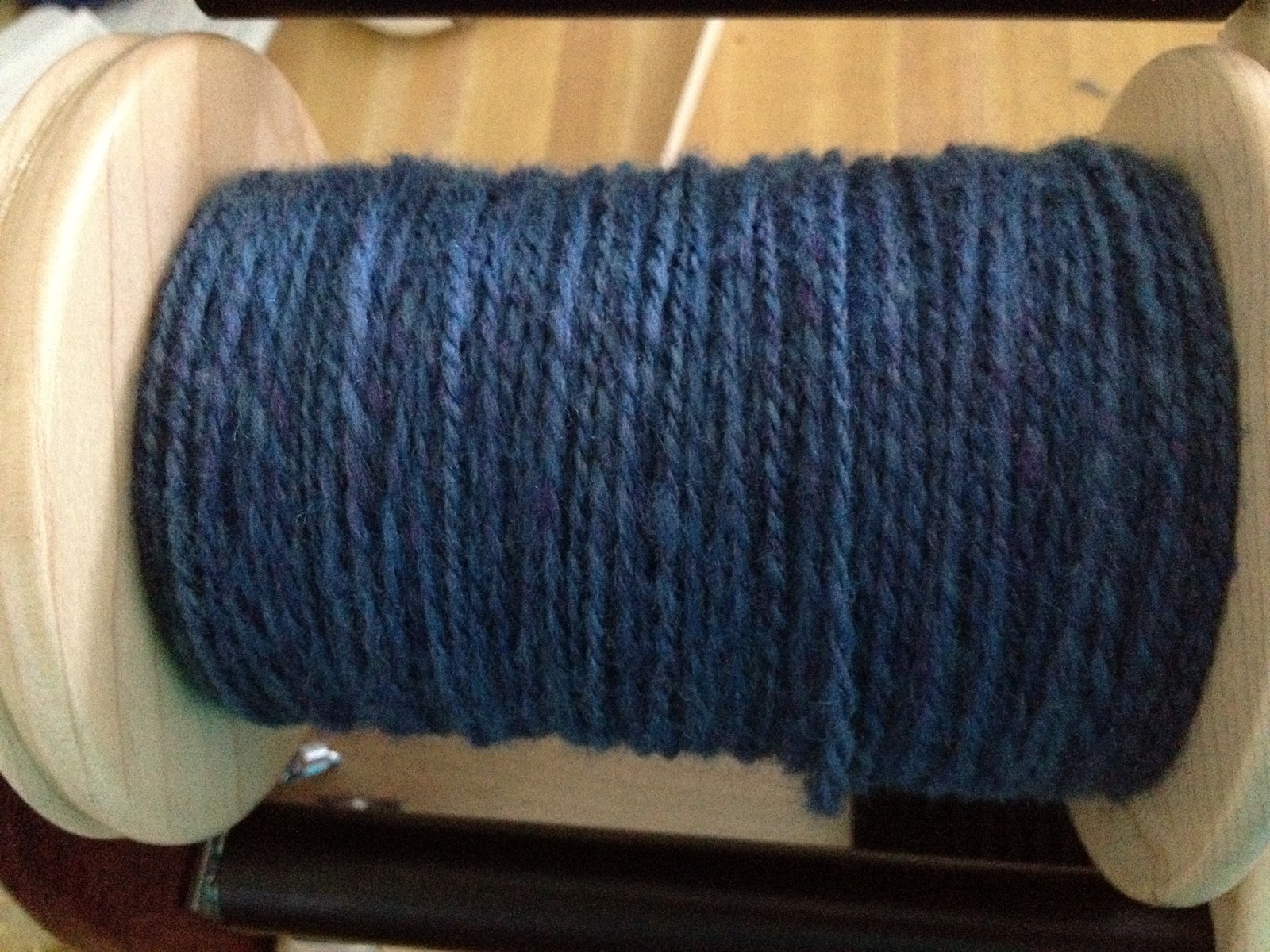
I started spinning the faux-rolags I made the other day. I didn't do a very good job, or the fiber isn't right or it isn't all that easy to spin. I am able to spin them but it isn't easy. This is merino which is is crimpy and maybe doesn't draft as easily. I haven't spun a lot of merino so I can't dismiss that option.

It isn't drafting very easily. When I spun from rolags, the fiber drafts easily. This needs a little help from my leading hand. I am getting a nice soft single, but it isn't easy. I am pulling the rolags apart and really spinning from the fold.

It is going relatively fast. So I think I can finish the first single tonight and I will spend more time making the faux-rolags for the second single. I will draft out the fiber more and make smaller rolags with a thinner inner core.

More later.

Thursday, November 22, 2012

First attempt at spinning cotton

 Since I won a supported trindle at the Tour de Fleece this year, I decided to learn to spin with it using cotton that I had acquired in various ways. It was all combed cotton top.

I started with the red skulls that I had won with the trindle. It was a lot of fun spinning with that.  In fact I spun with red skulls and a spider bowl on Halloween!

I initially spun only around 15-20 mins a day as it was tough getting the spindle to spin and draft at the same time. I did a lot of 'park and draft' type spinning. I spun the trindle to build up twist and then I would draft a bit and then spin it again.

Joining was tough in the beginning. I would end up throwing out bits of fiber when I joined as I just wasn't getting it all caught up right. That worked itself out as I got more proficient.

Over time, it got easier and I could draft and spin the trindle at the same time. I found the red skulls a little light as the cotton cop built up on the shaft.


 At Rhinebeck, I got some heavier disco balls, which helped a lot. The trindle spun slower but longer and that helped build up twist so I could draft out while it was spinning. I also found that sometimes, it was easier to just spin on my thigh rather than in the bowl. It depends on what you are wearing. It worked well on jeans but not so well on sweatpants.
 As the cops got built, I wound them off onto weaving bobbins. I used a shoe-box kate because it was easier than some of the other things I had around.

I ended up with 3 weaving bobbins worth of singles.
 The three weaving bobbins fit nicely on my new Will Taylor kate and I plied from the largest and one of the others first. After the smaller of the two ran out, I started the third. One lesson I learned was not to leave the cotton dangling while plying. I put a rubber band around the weaving bobbins so I wouldn't lose any twist. But I forgot about the single hanging there.

When I got back to plying later, I had to toss about 6-8" worth of singles before I had a strong single with enough twist in it. I made a bracelet with the last bit after the second bobbin ran out and finished plying as usual. I added a good bit of plying twist and there was a lot of twist in the singles.

 There is a decent amount of yarn from all this. It is essentially 'free' yarn as I paid for it as part of a class or a retreat. I thought I would just have a sample skein but I think there is enough to make something with it.


As you can see, the skein is skewing to the left, to the plying side, to show how much plying twist I put in. This is pre-finishing.

Finishing cotton seems to be a matter of many different opinions. The Intentional Spinner says that it should be finished similar to protein fibers. Spin Control says it should be boiled for 30 mins with washing soda. Stephanie Gaustad also says boil with washing soda in her Spinning Cotton video. I found boiling with baking soda and boiling with detergent as other recommendations on the web. Since I didn't have washing soda and I wasn't going to buy some for this skein, I just boiled it for 30 minutes without any additions.

I then cooled it immediately with cold water, squeezed out the water, snapped it between my hands and also thwacked it for good measure before hanging up to dry. The skein is straight now. Let's see how it feels when it is dry.

Overall, a successful experiment. I am very comfortable with the spindling technique, I liked spinning the cotton and while this yarn is a bit thick-and-thin, I definitely got more even at the end. So I can produce a nice yarn if I do this again.

I am now going to start some supported spindle projects with wool and see how that differs from cotton.

Friday, September 21, 2012

Fibery doings and planning


 I did a lot of spinning and knitting this week. I spun and plied a lac and indigo dyed roving from Handspun by Stefania. I bought this at Rhinebeck last year after sampling her fiber during my spinning class with Amy Tyler. It started off looking like this...
and ended up like this...

I spun it woolen - long draw and it was interesting to see that as I progressed through the 4 oz, it got thinner and thinner. I divided the fiber equally by weight for each bobbin but the second bobbin was about 1.5 times as long as the first!

On the knitting front, I have been working on my second Dancing Cranes stole. I have one half a repeat left. It looks like a mess now. I will probably do a blog post on blocking it so you can see the process. This is a linen/silk fiber from ColourMart. I bought 3 cones of it and used the first color to make the first Dancing Cranes stole. This is the second color and see below for the third one. It is a bit stiff to knit with but softens up nicely after washing. Linen/silk is extremely durable and easy to maintain and will get softer and softer with use and washing.

Now onto the plans...
I found these 14 skeins of Jamieson Double Knitting yarn. Given the fact that these are skeins, I wonder if I got a good deal on them when they changed the packaging. I am wondering what to do with them. There are 170 yds of each color and only 1 skein each. Any ideas?
 After the Dancing Cranes stole is done, I am going to knit a lace plaid stole. It is loosely based on Rhodocrosite by Norah Gaughan. More on that as I start knitting it. This is the third of the linen/silk cones I bought.
It is a pretty teal color. It would look lovely with jeans, which is exactly what I was thinking as I spun the indigo-lac dyed yarn above. As I spun over my jeans, the fiber blended almost invisibly with my jeans-clad thigh.

So that is it. As we finish one project, our minds are already rapidly moving on to the next one so that we are ready to cast on right after binding off. 

Wednesday, August 22, 2012

Long draw lessons

Before I forget, I wanted to write up what I learned about long draw while in Maggie Casey's class. Before I went to the class, I had done a few long draw projects but I was not happy with the results. I was spinning lumpy, bumpy yarn and while it was useful, I didn't feel as if I was getting the lovely, even, lofty and elastic fiber that woollen spinning can make.

Maggie is the queen of long draw so I was very excited to learn at her feet. I wasn't disappointed. We started with carding and making rolags. A freshly made rolag is a joy to spin. In fact, the process of teasing and carding fiber to make rolags is very satisfying in its own right.

I have posted pictures of the fiber and the rolags and the spun fiber in my first post after the class. What I am going to talk about today is what enabled me to spin a nice, consistent single.

So the fiber prep is the first step. A freshly carded rolag is easier to spin evenly than one that has been sitting around a while. I just finished spinning the batt I made in class and it wasn't as much fun as spinning the rolags.

Second is speed. A nice even treadle pace that is not too fast is key. Maggie says that one has to keep the drafting just ahead of the twist. Her analogy was that it was like chasing her dog. You can run after the dog but the dog is going to stay slightly ahead of you. The dog is the drafting and you, the chaser, are the twist. I found that it was easier to hold the single for a few extra treadles before letting it wind on, than treadling fast and trying to draft ahead of the twist.

The third a-ha moment came when I realized that I could hold back the twist. My right index and thumb open to let the twist through and close to hold it back. A regular rhythm to this opening and closing is good but you can hold the twist back a fraction of a second longer if you feel that it is getting too close to your drafting. In my case, my left hand is my fiber hand. So that hand is pulling back while the front hand is in one place controlling the amount of twist that is between the hands.

I was able to also do an unsupported long draw in class and it is a fun thing to do. But there is no need to do this. Your other hand can and should help, if needed.

I also found that it is helpful to pinch off a bit of the rolag and just draft that in one session. If you hold the rolag well back from the end, you get a lot of fiber that drafts out and you end up with more slubs. The amount of fiber that goes into each length of yarn before you let it wind on (usually about 2-3 ft) should be the same if you want an even single. This was also a big revelation.

Lastly, if you do get slubs, it is easy to even them out. Stop treadling. Wind the yarn to the left of the slub around your left hand (holding the fiber) and when your left hand is at the slub, wind the yarn to the right of the slub onto your right hand. Now the slub is all that is between your hands. I untwist the yarn at each end of the slub by unspinning with my right hand until I can thin out the slub. I usually start with the slub closest to the orifice, then I move away from the orifice to the next one. When all the slubs have been worked out, I start treadling again and let the yarn wind on.

There it is. Using all these techniques, I was able to spin quite a bit of yarn using the long draw method. Practice also makes perfect and I wanted to make sure I let the muscle memory build. So I bought an art batt at the Harrisville Designs store and spun it during the evenings. I also used the long draw drafting method when Maggie asked us to spin singles so we could learn plying.
 This is the skein I spun from the art batt. This picture shows a truer color than the one below.
 This one shows the variation in color a little better and you can see the thickness of the plied yarn against the US quarter coin.
 This was the yarn I spun to practice plying. I used three different colored rovings to do this. Maggie wanted us to use 3 different colors so we could see the plying twist clearly as we were plying.
Finally this is the first skein of the Lincoln-Corriedale fleece we worked on. I have enough spun for a second skein but I have to ply that. None of these are finished.

I like spinning long draw. It reduces the stress on my hands because the movements are so different from spinning worsted. I like the variety. You also end up spinning much faster when you spin long draw. However, for me, I get less yardage from spinning long draw. So it has its pluses and minuses. I am now going to spin a few skeins long draw so I can ensure my muscles are well and truly trained in the technique before I go back to worsted spinning.