Showing posts with label navajo rug. Show all posts

Wednesday, March 14, 2018

More spinning, weavi, some knitting

I have been in a spinning mood. I am winding a warp for the floor loom but mostly I've been spinning.

I'll start with the knitting as it is easier. I finished the red fingerless mitts with some leftover yarn. They only needed the thumbs. The thumbs are fat because the yarn is thicker but when I wear them, they are OK.

I also started these flip-top fingerless mittens in India but they've been languishing. I really don't like knitting mittens. Anyway they are done. They match the practice scarf I did on the floor loom. The yarn for the mittens is the weft although I used a little of the warp when I ran out of yarn. You can see that in the top of the left mitten.

My spindle spun thick yarn is plied. I had to hand wind it onto the bobbin for the last few yards as it wouldn't wind on because the bobbin was so full. But I didn't want to make a skein for a few yards. So I persevered and managed to finish it. This is lac and cochineal dyed roving from Handspun by Stefania. I got it some years ago at Rhinebeck.

 I also finished the little Navajo rug. It looks crooked because I let the sides draw in too much so the fell line (where the weaving ends) got tilted. I filled it in with black but as a result, the rug looks crooked. I am pretty pleased with it.

I have also finished spinning an Onyx-to-Crimson gradient from Fiber Optic. But all you see is black on the bobbin so I will post pictures after it is plied.

I also plied and semi-finished a small cotton sample skein on the charkha. One is supposed to boil cotton in an alkaline bath to finish it. I didn't want to do that for a small skein so I will spin some more and finish it all. I just soaked this in a warm water bath. It is a bit thick and thin but seems to be yarn.


I spent some time pondering how to ply this. There is a built-in lazy kate on the Bosworth charkha but the angle from that to the spindle is a bit weird. Maybe I will use that another time when I have more confidence. I ended up winding a 2-ply plying 'ball' on a soft foam core left over from some yarn. I could have put this on my lazy kate but I decided to just let it roll around on the floor. It worked well although there is too much plying twist in the yarn.

That is what I've been up to. Next up is warping the floor loom and plying the gradient. Plus I am going to swatch for a sweater, and am spinning more cotton and spindling the purple cashmere/silk.  I will finish up the travel next week.

Tuesday, February 20, 2018

Spindle love

I was talking to someone about pulling out my spindles and I finally did on Friday. I took a Trindle to the spinning guild meeting and fell in love with spindling all over again.

On Saturday, I finished up the doubleweave sampler from last November's class. I'll post a picture of it when I pull it out again to sew the ends and finish it. I wove 1" tubes across the width alternating the colors. I am going to make it into a circular needle case.

But back to spindles. That session on Friday night made me continue to spin a bit every day. I also took out my tiny spindles because I won a tiny Bee Jenkins at their New Year's Bee drawings. It weighs 2 g and I have to show you a photo in context. You can see it here at their site.  I spun a little on it using the sample fiber that came with it to cushion it. It is a Pygora/merino blend and is absolutely gorgeous. Of course the little spindle backspins a lot so it is slow going to spin on it.

But I got the Kuchulu and my 3D printed Snyder Spindles Destiny Turkish and got back to spinning the cashmere/silk from Corgi Hill Farms that was my Tour de Fleece spinning from 2015. I was spinning it on a Nano Trindle and the cop is all messed up. That made me put it in time out. And I decided to spin it on the Turkish spindles instead.

First I struggled with getting a self-leader on the Destiny,. It has 4 arms and they were all flailing about as I tried to spin the leader. I generally do some variation on this method by Wanda Jenkins.

So I started spinning a leader on my Finch Turkish with some discarded yarn I found in the spindle box. I must have been teaching someone to spin because it was all thick and thin with varying amounts of twist. I spun it and plied it but I didn't like putting it on the Destiny. So I went back to my usual method and with a little patience managed to get it started. But I don't like spinning cashmere/silk on it. The wooden shaft has enough grab that it snags the yarn. But it is a lovely spindle and I should spin something on it.

There they are. The Kuchulu on the right and the Destiny on the left. Yes, that is a whole lotta purple.


And here is the thick yarn on my Trindle with the heaviest arms I own. This shaft is only set up for 3 arms but I could switch to another one which has 6 holes in the neoprene ball and get a heavier spin. But this is doing fine, in fact it is easier than the heavier spindles I was using. I am also winding the cops off as soon as I am done so they don't get all messed up. There is a big plying ball that is growing day by day as I wind off from the Forester and the 3D printed top whorl Snyder Spindle. I have a paper towel roll with more singles that I wound off my Bosworth before donating it to a new spinner. So each cop I spin on this one has a matching second ply coming off already spun yarn. That is all that is left of 8 oz so it should be ready for plying soon.

I am also making progress on the Onyx to Crimson gradient but it is very boring taking photos of it. It is at the point where the red is almost black, just before the all black. It is hard to even see on the bobbin. I had to resort to putting a spinning cloth on my lap so I could see what I was spinning.

The Navajo rug is almost done. Someone was getting rid of some unwanted straight needles at the guild meeting and I snagged 2 as shed sticks. Mine went from really fat to pretty skinny and these two fit nicely in between. But it is almost time to remove the two heddles and work on picking up every other strand. There is only 1" left on top and it is already difficult to get sheds. I might try one or two picks more with the heddles before I remove them. 

Monday, February 12, 2018

New fiber skills

I went to India for 3 weeks to mostly visit family although we did a couple of days of sightseeing also. More on the sightseeing later.

First of all, the scarves and towels I made were received very favorably. I was surprised to some extent because knitted gifts were received well by some but not with this level of enthusiasm. I think it is due to the fact that there is limited use for knitted items in hot Chennai.

I generally just visit when I go to India. I don't have a long shopping list any more. I used to, because everything was not available here. But now I can get most things here. I wanted to buy some stretchy sari blouses, a never-ending quest. I want colors I can wear with my classic Kanchipuram silk saris so I want the traditional colors. Well, they never have them. They have more 'exotic' colors. That is great when I want to match a new sari but not so great when I want ones that will go with a variety of the saris I already own. So each time I buy one or two that I think will match. This time I got a dark blue. I bought an orange to match a new sari and a few for my sister.

I also used to buy a Christmas gift for my hair stylist. She is more of a friend than a hair stylist as I have been going there for more than 30 years. But these days, I make her a gift so there is no need to buy. I buy a gift for her when I travel outside India but I've already bought her a lot of the things that I think are nice gifts from India.

This time I had cotton punis on my shopping list as a major item. I spent a whole morning googling and calling stores where I thought they would have them. No one in Chennai had them or even seemed to know what they were. Then a Ravelry friend from Kolkata told me she got them from a local seller who travels to Wardha in the state of Maharashtra to buy them. The Gandhi Sevagram Ashram there makes and sells them. But there is no online shop. However, she generously sent me some by courier. What a lovely gift!
They come in 100 g bundles wrapped in newspaper.

After my return, I started spinning cotton on my new-to-me Bosworth charkha. I bought this last summer from another Raveler.  She included some easy-to-spin colored cotton sliver so I started with that. That is my first new skill. It is interesting. I have thread that varies from very fine to not-so-fine and I need to decide what degree I want and then produce it consistently. I've spun 1 spindle full.


I also started working on the Navajo rug I started in the class at Rhinebeck. Navajo weaving is very different from tapestry weaving, which it resembles. The technique interlaces the weft threads every other row so the rug is nice and tightly woven. This took me a bit of time to master. Fortunately, I had video taped the instructor when she demonstrated key techniques. Going back and watching that, trying it out, watching again, watching other Navajo weavers weave, etc. finally made it click. I am doing pretty well given I am designing on the fly as the Navajos do. It means I have to backtrack some times and of course, I have to unweave when I make a mistake - for example, I didn't cover a warp thread for 2-3 rows and had to go back.

I have finished the design of the blocks and done a stripe to delineate it from the next design. I am not making this symmetric as I don't want to have to manage the height of each piece. The warp has to be completely woven and it is tightly packed in. I am just going to do another pattern on the other side and end with stripes.

There are two sheds. The top heddle is the dowel on the top that is threaded through every other warp thread. Then there is the pull heddle that is hanging below it. On every pick, you thread something through one of the two sheds and then that holds the shed open to do the weave. I was using a pick up stick but now that is too wide so I am using a fat knitting needle. I will go down to a smaller one in a bit and then eventually one has to remove both dowels and weave using a needle. I am beating with a metal hair pick, some dog combs, and occasionally I put the pickups stick in and press down with it to make sure I have a horizontal edge.

On the non-new skill area, I knitted a hat and undid and reknit it when I was in India. I wanted to make a pair of fingerless mitts to match but I ran out of yarn. I undid the hat and ripped out an inch worth of yarn and reknit the crown. But that still wasn't enough for the thumbs. I found some red yarn, slightly thicker, and I will finish the mitts with that.

Before I cut an inch off the length.


After the re-knitting.

I also started another pair of fingerless mitts. They are still in progress and I don't have a photo.

I plied the red yarn I spun before I left. This was the last of my Tour de Fleece projects from last year. I am very happy with the yarn. That is the bobbin of plied yarn on top. I am now spinning the gradient on the bottom. I will weave a shawl with the two together after spinning. I have 560 yds of the solid red - it was 8 oz of fiber. I have 8 oz of gradient. Right now I am thinking of the solid red for the warp and the gradient for the weft. I'll spin each gradient braid separately and ply them together.

As you remember, the solid red was actually spun by holding a cool red and a warm red together. I am quite pleased at the result. It has a lot of liveliness in color and the yarn is very bouncy. One braid was Polwarth/silk and the other was superwash merino/alpaca/nylon/Tussah. I was afraid about how it would react when I finished it. I was gentle and I will be gentle when I finish the weaving. I don't want differential shrinkage where the non-superwash wool shrinks and the rest doesn't. The gradients are merino/silk so will behave like the Polwarth/silk. Note to Self: read the fiber content before you put fibers together.

I also received some lovely cotton yarn for weaving from another Raveler friend in Chennai.

There are about 250 g of each color so 1 kg in total (2.2 lbs)

She and I went to Shuttles and Needles in Chennai, which is a fabulous store. They are dealers for Ashford and Saori and have looms set up to weave and spinning wheels and spindles as well as knitting supplies. I spun a little on one of the Ashford spindles when I was there and bought one with some fiber for my sister-in-law who was fascinated by both my weaving and my search for punis. Unfortunately, I only went there two days before I left so she had 1 day worth of teaching. Now we are trying it using WhatsApp.

I also boiled the marigold flowers I had been freezing over the summer. I simmered the flowers for 1 hour on day. Let it cool and then simmered again for another hour the next day. Strained out the flowers on the third day. I put a white skein into it and simmered for 30 mins and let the yarn cool in the dye pot overnight. There was still dye left so I added two more skeins to over dye them. I didn't mordant as the recommendation in Jenny Dean's Wild Color was to use alum sulfate on protein fibers and I only had alum acetate. I have the original edition.

I think the color would have been more intense if I had used a mordant. But I am happy with the results. There was more dye in the pot but I discarded it as I didn't have any other fiber that was ready to dye.
 
This was the pure white skein. The next two were overdyed and are slightly muted from the originals, which I thought were too bright.

Overdyed:

Original:

Overdyed:

Original:


And that is it. I am really enjoying all this. I have my next weave planned but will not start till the Navajo rug is done. It is going to use up a bunch of leftover yarns.

Monday, November 27, 2017

Navajo Weaving class at Rhinebeck and Navajo rugs

The other full day class I took at Rhinebeck was on Navajo weaving. I have always been fascinated by rugs but not to the extent of learning how to knot them. The process of rug hooking doesn't interest me but weaving rugs does. I don't think I will become a rug weaver but making the occasional rug is definitely in the cards.

I had heard good things about the Navajo weaving class that was offered last year at Rhinebeck. So when it was on the list of workshops for this year, I signed up. It sold out pretty quickly but the teacher was willing to add another day so more people were able to take it. She vends at the festival so can only teach on Thursday and Friday.

The teacher is a member of the Navajo Nation and her whole family weaves. She showed us an example of her niece's weaving when she was a child as well as an adult. As a 5-year old, she made a striped rug. These rugs are all made from vertical and horizontal lines - which is all the patterning we learned in class. One can also make diagonals but a one-day class isn't sufficient to teach that also.


This one has some diagonal lines on it.


We started off with warped looms but we had to add the side warps to the loom. These are single strands of wool that hide the un-dyed warp on the sides. They are used to eventually make the tassels at the ends of the rugs. Once we did that, we created our two sheds. One shed is created by looping thread around a dowel and every other warp strand. The second shed is picked up with the beater behind the dowel shed.


Here you can see the loom set up with the two sheds. The dowel shed is kept up at the top except when used in weaving. Here you can see the second shed being created behind it. You can also see the edge of the rug in brown at the bottom.

We got 8 oz of yarn in any combination of colors we wanted. I picked relatively traditional colors - black, tan, natural and a red.

Once we had all this set up we started weaving. You weave with lengths of yarn and add on as needed. First we did an edging stripe in the same color as the edge yarn. Then we learned how to add another color. It is very similar to other weaving except that one is manipulating everything with one's fingers vs. using a shuttle. Adding in another color is how you do horizontal stripes.

After we had woven a stripe or two, we learned how to do vertical stripes. This is like tapestry weaving where you interlace the two colors every other weft pick (or row).

Since she demonstrated everything so quickly, I took videos of each step so I could refer back to them when I finish my rug.


This is the current state of my rug. You can see the black edging warp. I am making a cross like figure and adding in more colors as I widen the arms. I am not going to try and make it symmetrical as that requires not only measurement but accurate beating to make sure the same number of weft threads end up in the top as at the bottom.

The weft is beaten in with a tapestry beater. She lent us these tools for the class. I will use the metal hair pick I used when making my jeans rug along with a pickup stick to beat into a straight line periodically. One weaves this in sections and one can build up one side and then the other to compensate. However, at this time, I decided to stick to doing both at the same time due to my lack of experience in making them match!

As the rug get higher and higher and there is less room, one starts using narrower pickup sticks and then eventually a knitting needle or dowel to make the sheds. The dowel shed will have to come out also. One keeps packing the weft down as much as possible and eventually when there is no space left, one is done.

The finishing is simple, undo the twine that holds the rug to the loom on both top and bottom. Then take the ends of the edging warp and knot them together.

They can then be braided or twisted like a fringe.

I am designing on the go like the Navajo women do. Right now I have only vague ideas of how the rug will look.

I spoke to a young Navajo man at the Painted Desert Inn in the Petrified Forest National Park in Arizona. His grandmother was weaving but she had gone out for a break and didn't return while we were there. He said that in his family, men don't weave. So he didn't show us how to do it. But he demonstrated how the wool is carded and spun using regular wool cards and Navajo spindles. His spinning wasn't that good either because he said he was just learning. It is a tightly spun woolen singles yarn which is dyed using natural dyes like cochineal, various woods (he gave us Navajo names so I don't know what they were), and plants. His grandmother had a rug on a larger frame than the one I am showing above but it was very similar.

He said that traditionally the warp was on two branches or dowels top and bottom. No sides. The top was attached to a tree branch where the women were tending their sheep. The bottom was pegged into the ground to tension the warp. When the sheep needed to move on, the loom was detached, rolled up and carried to the next spot. The entire process of carding and spinning and weaving was designed for a nomadic life, following the sheep.


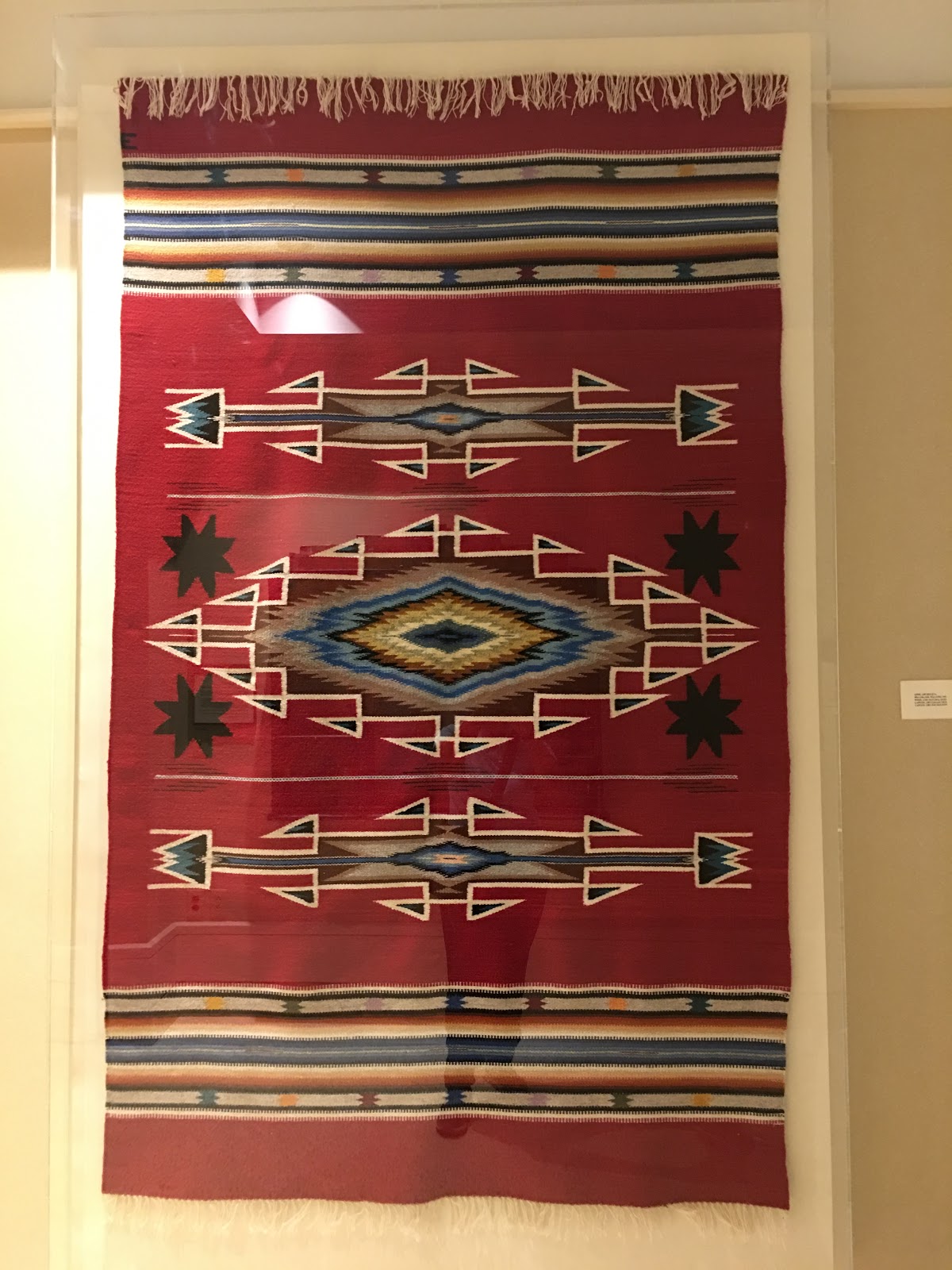
The New Mexico State Capitol is an art gallery. It is free to come in and look at the hundreds of painting, mixed media art, weaving and sculpture that are featured in the corridors. It is weird to walk in among people who work there but that is the way it is designed to be viewed. I took photos of a number of the art pieces and have included the traditional Native American weavings here. Some are Navajo and others are by other tribes.

More on the state capitol when I talk about that trip. I also have photos from the Painted Desert Inn discussion but those are in the camera and I need to sort through them.


Saturday, November 4, 2017

Rhinebeck 2017


Updated to add two more photos of the dyeing class.


It has been really busy around here and that is why there hasn't been any blogging. We were out in Europe for 2 weeks and I came back right before Rhinebeck. This year Rhinebeck expanded out into 4.5 days because I helped with workshop setup also. Usually I just help pack up on Sunday.


It ended up being quite tiring because I was there to help with class check-in at 7:30 (Thurs/Fri) and 8:30 (Sat/Sun). I thought I'd get home early on Thurs after class but class ran late. On Friday, I volunteered at the fleece judging as a scribe so it was late. I usually try to leave either early or late on Sat and Sun to avoid the traffic. So most days were long. It is a 45 min drive for me one-way. But it is so much fun that I don't care.

I took 3 classes this year. On Thursday I took 'Dyeing Cotton Naturally' with Jane Woodhouse. Jane is a great teacher. It was a long day as we made many, many samples. First we dyed natural colored cotton which had been mordanted with alum acetate. Then we dyed cotton that had been mordanted with alum and a tannin. Lastly we made stock solutions and did color blends.

Each of the first two sets twas done 3 ways: the dye as is, with an iron modifier and with an indigo over-dye.


The challenging part was labeling and dividing up the skeins so we each had a sample of each yarn. I finally got around to organizing my samples! I now need a big envelope to store them.


On Friday, I took a Navajo Rug Weaving class. We got small pre-warped looms and 8 oz of yarn to weave with. It took a while for her to explain the basics. She taught us how to weave vertical and horizontal stripes. Diagonals were not included in the curriculum for this one day class. It was fun and I need to get back to it. The teacher was Marilou Schultz who is a member of the Navajo Nation.


The last class I took was on Sunday. It was a 1 hour 'Made in the Moment' with Leslie Wind. That was a lot of fun! I made a pin and 2 cable needles. Plus, because we were the last class of the weekend, we each got some samples from her.


The top pin is the one I made. The other two are her samples.


The cable needles I made. The left one is called 'Hurrah!' and the right one is 'Angel'. 

Someone gave me 2 bags of unlabeled undyed fiber and another person gave me a bag of Into the Whirled fiber. The only fiber I bought was odds and ends that Briar Rose had dyed. She is getting out of the fiber business and just dyed these to use up the ends. I bought a featherweight Bosworth spindle. I haven't photographed any of my acquisitions yet so that will be in the next post.

Right after Rhinebeck, I had to focus on an educational forum I was helping organize and canvassing for the election. So the fiber content has been minimal BUT, I was able to warp and weave a scarf on my Baby Wolf loom. That was exciting. I am already planning the next project on it as well as what I'm going to do on my rigid heddle loom.


Scarf on the loom above and finally finished below. It is a variegated weft with an almost solid gray warp. Both yarns are cheap 'sock' yarns I bought in China. They are quite soft but not very durable for socks.


I also started a pair of Two-At-A-Time (TAAT) socks while I was traveling. I have finished them up to the heels. They are for a guild demo so I am going to stop there till the guild meeting. This way I can show back and forth knitting on the two socks as well as how to knit on them in-the-round.


I finished the wrap I worked on when I was on the first trip and also a little infinity scarf/cowl from a skein of the most luscious yarn I have ever touched. It is called Road to China. I don't seem to have a photo of the wrap. I'll take it and post next time.


Rhinebeck was very warm this year. But it was cold in the am so I wore a sweater or shawl every day and then ended up taking them off around 10 am. They went back on right before I left at 6 or 7 pm.  I did get a chance to finally wear my Grapevine sweater.


In order to catch up and write about both the travel and the fiber activity, I am hoping to do 2 posts a week for the rest of the year.