Showing posts with label fingerless mitts. Show all posts

Wednesday, March 14, 2018

More spinning, weavi, some knitting

I have been in a spinning mood. I am winding a warp for the floor loom but mostly I've been spinning.

I'll start with the knitting as it is easier. I finished the red fingerless mitts with some leftover yarn. They only needed the thumbs. The thumbs are fat because the yarn is thicker but when I wear them, they are OK.

I also started these flip-top fingerless mittens in India but they've been languishing. I really don't like knitting mittens. Anyway they are done. They match the practice scarf I did on the floor loom. The yarn for the mittens is the weft although I used a little of the warp when I ran out of yarn. You can see that in the top of the left mitten.

My spindle spun thick yarn is plied. I had to hand wind it onto the bobbin for the last few yards as it wouldn't wind on because the bobbin was so full. But I didn't want to make a skein for a few yards. So I persevered and managed to finish it. This is lac and cochineal dyed roving from Handspun by Stefania. I got it some years ago at Rhinebeck.

 I also finished the little Navajo rug. It looks crooked because I let the sides draw in too much so the fell line (where the weaving ends) got tilted. I filled it in with black but as a result, the rug looks crooked. I am pretty pleased with it.

I have also finished spinning an Onyx-to-Crimson gradient from Fiber Optic. But all you see is black on the bobbin so I will post pictures after it is plied.

I also plied and semi-finished a small cotton sample skein on the charkha. One is supposed to boil cotton in an alkaline bath to finish it. I didn't want to do that for a small skein so I will spin some more and finish it all. I just soaked this in a warm water bath. It is a bit thick and thin but seems to be yarn.


I spent some time pondering how to ply this. There is a built-in lazy kate on the Bosworth charkha but the angle from that to the spindle is a bit weird. Maybe I will use that another time when I have more confidence. I ended up winding a 2-ply plying 'ball' on a soft foam core left over from some yarn. I could have put this on my lazy kate but I decided to just let it roll around on the floor. It worked well although there is too much plying twist in the yarn.

That is what I've been up to. Next up is warping the floor loom and plying the gradient. Plus I am going to swatch for a sweater, and am spinning more cotton and spindling the purple cashmere/silk.  I will finish up the travel next week.

Monday, February 12, 2018

New fiber skills

I went to India for 3 weeks to mostly visit family although we did a couple of days of sightseeing also. More on the sightseeing later.

First of all, the scarves and towels I made were received very favorably. I was surprised to some extent because knitted gifts were received well by some but not with this level of enthusiasm. I think it is due to the fact that there is limited use for knitted items in hot Chennai.

I generally just visit when I go to India. I don't have a long shopping list any more. I used to, because everything was not available here. But now I can get most things here. I wanted to buy some stretchy sari blouses, a never-ending quest. I want colors I can wear with my classic Kanchipuram silk saris so I want the traditional colors. Well, they never have them. They have more 'exotic' colors. That is great when I want to match a new sari but not so great when I want ones that will go with a variety of the saris I already own. So each time I buy one or two that I think will match. This time I got a dark blue. I bought an orange to match a new sari and a few for my sister.

I also used to buy a Christmas gift for my hair stylist. She is more of a friend than a hair stylist as I have been going there for more than 30 years. But these days, I make her a gift so there is no need to buy. I buy a gift for her when I travel outside India but I've already bought her a lot of the things that I think are nice gifts from India.

This time I had cotton punis on my shopping list as a major item. I spent a whole morning googling and calling stores where I thought they would have them. No one in Chennai had them or even seemed to know what they were. Then a Ravelry friend from Kolkata told me she got them from a local seller who travels to Wardha in the state of Maharashtra to buy them. The Gandhi Sevagram Ashram there makes and sells them. But there is no online shop. However, she generously sent me some by courier. What a lovely gift!
They come in 100 g bundles wrapped in newspaper.

After my return, I started spinning cotton on my new-to-me Bosworth charkha. I bought this last summer from another Raveler.  She included some easy-to-spin colored cotton sliver so I started with that. That is my first new skill. It is interesting. I have thread that varies from very fine to not-so-fine and I need to decide what degree I want and then produce it consistently. I've spun 1 spindle full.


I also started working on the Navajo rug I started in the class at Rhinebeck. Navajo weaving is very different from tapestry weaving, which it resembles. The technique interlaces the weft threads every other row so the rug is nice and tightly woven. This took me a bit of time to master. Fortunately, I had video taped the instructor when she demonstrated key techniques. Going back and watching that, trying it out, watching again, watching other Navajo weavers weave, etc. finally made it click. I am doing pretty well given I am designing on the fly as the Navajos do. It means I have to backtrack some times and of course, I have to unweave when I make a mistake - for example, I didn't cover a warp thread for 2-3 rows and had to go back.

I have finished the design of the blocks and done a stripe to delineate it from the next design. I am not making this symmetric as I don't want to have to manage the height of each piece. The warp has to be completely woven and it is tightly packed in. I am just going to do another pattern on the other side and end with stripes.

There are two sheds. The top heddle is the dowel on the top that is threaded through every other warp thread. Then there is the pull heddle that is hanging below it. On every pick, you thread something through one of the two sheds and then that holds the shed open to do the weave. I was using a pick up stick but now that is too wide so I am using a fat knitting needle. I will go down to a smaller one in a bit and then eventually one has to remove both dowels and weave using a needle. I am beating with a metal hair pick, some dog combs, and occasionally I put the pickups stick in and press down with it to make sure I have a horizontal edge.

On the non-new skill area, I knitted a hat and undid and reknit it when I was in India. I wanted to make a pair of fingerless mitts to match but I ran out of yarn. I undid the hat and ripped out an inch worth of yarn and reknit the crown. But that still wasn't enough for the thumbs. I found some red yarn, slightly thicker, and I will finish the mitts with that.

Before I cut an inch off the length.


After the re-knitting.

I also started another pair of fingerless mitts. They are still in progress and I don't have a photo.

I plied the red yarn I spun before I left. This was the last of my Tour de Fleece projects from last year. I am very happy with the yarn. That is the bobbin of plied yarn on top. I am now spinning the gradient on the bottom. I will weave a shawl with the two together after spinning. I have 560 yds of the solid red - it was 8 oz of fiber. I have 8 oz of gradient. Right now I am thinking of the solid red for the warp and the gradient for the weft. I'll spin each gradient braid separately and ply them together.

As you remember, the solid red was actually spun by holding a cool red and a warm red together. I am quite pleased at the result. It has a lot of liveliness in color and the yarn is very bouncy. One braid was Polwarth/silk and the other was superwash merino/alpaca/nylon/Tussah. I was afraid about how it would react when I finished it. I was gentle and I will be gentle when I finish the weaving. I don't want differential shrinkage where the non-superwash wool shrinks and the rest doesn't. The gradients are merino/silk so will behave like the Polwarth/silk. Note to Self: read the fiber content before you put fibers together.

I also received some lovely cotton yarn for weaving from another Raveler friend in Chennai.

There are about 250 g of each color so 1 kg in total (2.2 lbs)

She and I went to Shuttles and Needles in Chennai, which is a fabulous store. They are dealers for Ashford and Saori and have looms set up to weave and spinning wheels and spindles as well as knitting supplies. I spun a little on one of the Ashford spindles when I was there and bought one with some fiber for my sister-in-law who was fascinated by both my weaving and my search for punis. Unfortunately, I only went there two days before I left so she had 1 day worth of teaching. Now we are trying it using WhatsApp.

I also boiled the marigold flowers I had been freezing over the summer. I simmered the flowers for 1 hour on day. Let it cool and then simmered again for another hour the next day. Strained out the flowers on the third day. I put a white skein into it and simmered for 30 mins and let the yarn cool in the dye pot overnight. There was still dye left so I added two more skeins to over dye them. I didn't mordant as the recommendation in Jenny Dean's Wild Color was to use alum sulfate on protein fibers and I only had alum acetate. I have the original edition.

I think the color would have been more intense if I had used a mordant. But I am happy with the results. There was more dye in the pot but I discarded it as I didn't have any other fiber that was ready to dye.
 
This was the pure white skein. The next two were overdyed and are slightly muted from the originals, which I thought were too bright.

Overdyed:

Original:

Overdyed:

Original:


And that is it. I am really enjoying all this. I have my next weave planned but will not start till the Navajo rug is done. It is going to use up a bunch of leftover yarns.

Friday, February 10, 2017

Back from vacation!

I've been silent for a while because we've been on vacation. We went for 2 weeks to Tanzania on a safari vacation and I will be writing about it in the next few posts. It was fabulous. Everyone who can, should go on a safari vacation at least once in their lives. It is amazing to see the sheer number of animals, at ease and at home in their natural environment. Tanzania has done a great job setting aside large areas as national parks (no domestic animals or humans living there permanently) as well as conservation areas which are shared with traditional tribes and their domestic animals. They also have hunting areas. But in the parks and conservation areas, all hunting is off-limits. So the animals are not bothered by the humans who are confined to their vehicles. It makes for a truly spectacular and unique experience.

Along the way, I finished knitting the other two pairs of wrist brace liners that I started in Dec.
 I knit this pair on the plane and on the first and last days we were in Tanzania when we had a little free time. Once the actual trip began, there was no time to knit.
I finished the first one of these on the plane coming home and the second one at home. I don't especially like the colors but I bought the red yarn without thinking about combining it. Then I found that a pair took a little over 2 balls so it would be a waste to buy 6 balls to make 3 pairs. The pink was the only color that the LYS had that even remotely went with the red. So there I am. Fortunately, these get worn under wrist braces and at night. With these colors there is no danger of my leaving them behind anywhere.

The yarn is CoBaSi from Skacel. It is a bit loosely spun and tends to split. Plus there isn't as much elastic in it as compared to Cascade Fixation, which is what I used for the previous generations of liners. Let's see how it holds up. I bought this because the LYS carried this and not Cascade. It tends to stretch out over a week's wearing but snaps back on washing. I'm all set for a few more years till these start to fray.

We arrived in Tanzania a day early and left a day later than the actual trip. The reason was that we didn't want to spend extra time in flying by adding connections and the prices on the route we wanted (NYC-Amsterdam-Kilimanjaro International Airport) were cheaper the day before and the day after. Cheaper than a hotel room and meals for 2 people.

Our first day was quiet. We went out to look around Arusha, the city we were living in. One of our tour group members' daughter had done a project in Arusha a few years ago. So we stopped by the place where she had worked. It is called Global Cycle Solutions and they create products that use pedal power as well other renewable energy to create solutions for developing areas like Tanzania.
It was interesting to see the small solar lamps that provide light where there is no electricity. The way it works is that a buyer can either buy the system outright, which is more expensive than they can usually afford, or they can pay a monthly fee for the use of the system. In the latter case, they are sent a code in a text that they enter into the system once they have paid. The code activates the system for the duration that they have paid for - a month, 3 months, etc.

We also saw an NGO incubator where GCS got its start. This is a place with tools and a workshop that allows entrepreneurs to come in and work out their prototypes and manufacturing. In the US we would call it a maker space.

 This is the workshop/maker space. There are some offices around it.
 This is an irrigation system that is being worked on or was worked on.
 This is an example of pedal power. In India, they manufacture a maize huller that is hand-cranked. That is the blue thing mounted on the cross bar of the bike. Here the hand-crank has been replaced by a gear that connects to the bike. When you pedal the bike the huller is driven and you can hull the ear of maize. The bicycle is on a stand because it doesn't need to go anywhere.

We spent the afternoon by the pool and I knitted while chatting and getting to know members of the tour group.
This photo is looking out over the gardens of the hotel.

 This is Mt. Meru, a relatively tall mountain close to our hotel.

The next morning we were going to climb the first stage of the ascent of Mt. Kilimanjaro, the highest peak in Africa. We went up the Marangu route to the first set of huts, the Mandara huts. Marangu is one of the easier routes and more comfortable than most because you can spend the nights in huts vs. tents. Climbing Mt. Kilimanjaro is a minimum of a 6 day trek. 5 days to climb where you do the last stage at night, spend 10 mins at the peak and immediately start your descent on the 6th day. The oxygen levels are low at the peak which is at 19,000 ft - give or take a few ft. And people don't use oxygen to climb so you can't stay up there too long. It is also the only high peak that is scalable without any mountaineering equipment. You just walk up.

Here is the information on the ascent from one of the companies that outfits you for it.
 These are some shots I took as we drove to Mt. Kilimanjaro - or Kili as it is affectionately called.

 Our first view of the peak from the road. The downside to the Marangu route is that you can't see the peak as you climb. It is all through forest.
 The start of our hike.
 Our guides. You have to be accompanied by guides when you climb. They make sure you are safe and they even carry your backpack if you want. I carried my own up to the top, though.

 Markers along the way. We had boxed lunches which we ate half-way up. Some of our party descended from the half-way point but 5 of us continued to the huts.
 Views on the trail. I was trying to capture monkeys and birds but I think I only got plants, no animals.

 Another marker.
 This is the entry to the park office at the huts on the left. Straight ahead to the right one is looking into Kenya and there was a city there we could see. But my camera couldn't capture the faint view.
 And the sign that told me I had reached the top. I had collapsed on the steps and one of the other members actually took this photo because it was higher up than the steps.
 On the way back home we were treated to a fabulous sunset.


Two photos of Kili at dusk. It was our last views of the mountain because when we came back at the end of the trip, it was a cloudy day and she was hidden in the clouds.

We got back to the hotel sweaty, dusty and exhausted, but thrilled that we had made it. I accrued more than 30,000 steps on my Fitbit that day.

The next morning we set off on the safari. All the other posts will be photo heavy.


Thursday, November 5, 2015

What do you do with hole-y socks? Part 1

I had to drive an hour away for work on Monday and Tuesday this week. Tuesday was also election day so I had to stop by the voting place on the way back. So no blog on Tuesday. Maybe Tuesdays are jinxed. Oh, and next week's post won't happen on a Tuesday either. I have to go to a professional society meeting. But Tuesday is a good day to shoot for!

Anyway, I am doing a mini-workshop at my spinning guild this month. The subject is recycling your socks. They asked me to do one on darning socks but I don't see any point in darning socks. I tried that when I first knit socks and they wore out. Back in the early 2000s. The problem is that the yarn around the darn is also weak so it gives way next. And so on. I even tried sewing on slipper soles and making slippers out of the socks. The holes just grew and grew and grew. So I quit.

Now I make the socks into other useful objects so one can enjoy them. Over the next few weeks, I'll share some of the items that I create from the socks. Today we will make a pair of socks into fingerless mitts. This took me 3 evenings for a pair.

Here is the hole in the heel. Assessing where the hole(s) are is the first step. You'll see later that I have to deal with a sock that has a hole in the ball of the foot. Heels are easy.


The next step is to look at the sock and decide what one wants to do. In addition to assessing where the hole(s) is/are, determine whether the sock was knit toe-up or cuff-down. You need to know that so you can cut and rip back. Knitting only rips back in the opposite direction it was originally knit in. You have to plan your cuts so you have yarn to knit up and finish the ripped edge.

In this case, the legs of the sock have a lovely lace pattern which I want to exploit. I also love this color and the yarn. In fact I was very sad when the hole developed. Making a pair of fingerless mitts will showcase the lace and let me enjoy it and the yarn for a while longer.


Snip a stitch and slowly pull out a row of sts. I like to do this right above the heel shaping if I am going to do something with the leg on a cuff-down sock. This way I get the most yarn to work with. On a toe-up sock, if you are making fingerless mitts from the leg, you have to cut precisely at the right point and then join in yarn to finish the cut edge. You can't rip back and re-use the yarn without a join.

When I first started, I used to cut the sock apart but I lost too much yarn that way. This can be slow going if the sock has started to felt. Take that into account as you decide what to do with the sock(s). In some cases, one uses only one sock or one part of one sock. 


Repeat with the other sock so you have both separated into legs and feet with the heel attached to the feet. Once the row is removed, the two pieces will fall apart.


 I checked the length of the leg against my hand. As you can see, it is way too long for a fingerless mitt. So I started ripping back.


I ripped back, measuring every few inches till I had a length that was good for a mitt. I kept the curly cuff for the wrist side and decided to a ribbed edge at the fingers. These are all design decisions you get to make.


You don't have to worry too much about sts unraveling when you don't want them to. They've been held in shape so long that they just sit there and wait to be picked up. In fact, sometimes they have become so friendly with their neighbors that it takes some effort to rip the rounds out.

If you typically knit socks with the same size needles, there are no decisions about needle size here. I always knit socks on 2 mm or US size 0 needles. If you knit with different sized needles, you need to pick up sts using the same size needles you originally used for the socks.

I like to use needles that are a bit blunt and slick for picking up these sts. The yarn is worn and you've just been unraveling it so sometimes it has split and a sharp needle just splits it further. Make sure you are picking up the entire st and orienting them correctly for the way you knit. I used Knitpicks metal dpns for this.


Based on the lace rib pattern, I decided to keep the purl sts between the lace sections intact. The lace section was 9 sts wide so I did a k3, p3, k3 across it and then the p2 between the lace sections. I did an inch of ribbing following that patterns: k3, p3, k3, p2 and repeat around. Then I bound off. If your sock has a different pattern or is rib or stockinette, you can just keep the existing rib or use any ribbed pattern that goes with the original leg pattern. 


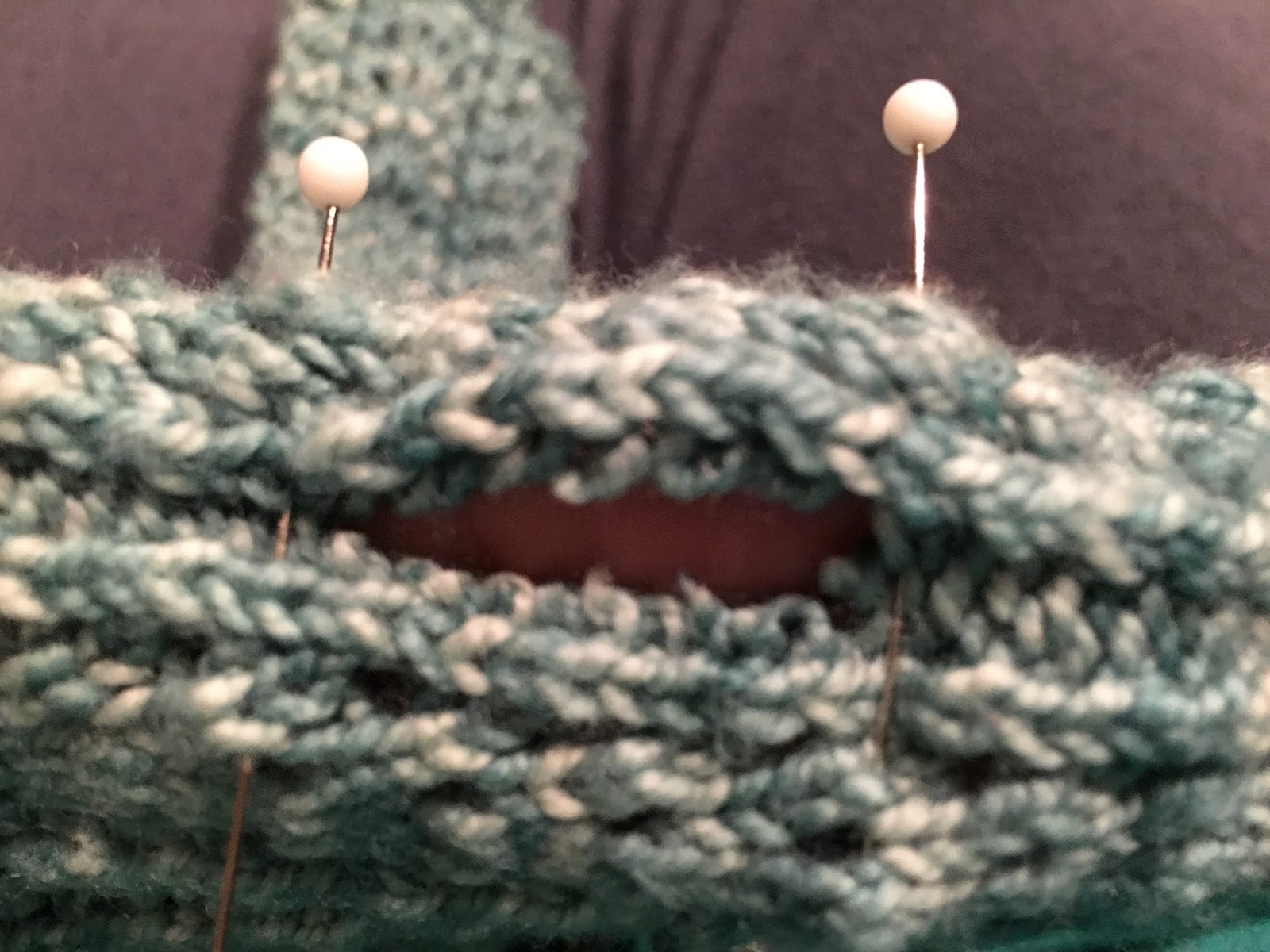
Once that was done, I measured again and marked my thumb position with a pair of pins. There is no thumb gusset so the thumb opening has to be a bit wider than if there was a gusset. Make sure the two mitts match.


I decided to snip between the two purl sts that separated the lace patterns. This is also something you take into consideration to make the mitts look as if they were mitts from the very beginning. I just cut in this case, but later I decided I would do a row of crochet on either side next time before cutting. It pulled apart a bit more than I wanted and since this is sock yarn, it won't felt together. You can see the cut above and below where I am holding it open a bit more.


Once it was cut, I picked up sts all around leaving a l-o-n-g tail in the beginning to neaten up that edge. Make sure you are picking up far enough from the edge so the new sts are secure. I did an inch of k2, p2 rib and bound off. Then I took the beginning tail and did a row of running st followed by a row of buttonhole st on the edge to hold the cut edge intact.


Repeat for the other mitt. You can see the little thumb edge above from the right side.


This view is from the wrong side where you can see my finishing of the cut edge.


There's the pair. All done. And on my hands below.


I had to take the photos one at a time as I needed the other to take the photo! I wore them at Rhinebeck! Next up we'll make a headband.